

Understanding the Emotional Patterns Behind Hyper-Alert Love
⏱️ 30-Second Triage Pause
If you are experiencing relationship stress right now, reading a long article can feel overwhelming. Skip directly down to The 3-Step Reality Check under the final section for an immediate 90-second mental cooling-off exercise.
At a Glance: Understanding Relationship Insecurity
The Core Struggle: Yearning for extreme emotional intimacy while living in constant fear of abandonment.
The Primary Trigger: Sudden changes in a partner’s text tone, responsiveness, or emotional availability.
The Healing Path: Shifting your focus from external reassurance to mindful self-regulation and inner calm.
Few things feel as deeply exhausting as a relationship ruled by constant emotional high alert. When you experience the world through an anxious attachment profile, love rarely feels like a safe harbor. Instead, it can feel like a stressful testing ground—an endless cycle of overthinking, re-reading text messages, and waiting for the other shoe to drop.
IIf you constantly find yourself checking your phone, measuring the exact timing of a partner’s replies, or feeling a wave of hidden stress when they seem slightly quiet, you aren’t just “overthinking.” You are experiencing a deeply rooted relational pattern that shapes how your mind processes emotional reassurance and human connection.

Pillar 1: The Loop of High-Alert Reactions
At its core, an anxious attachment profile is driven by a painful internal paradox. You desperately crave intimacy, yet the moment you get close to someone, your mind convinces you that the connection is about to disappear.
In relationship psychology, this is known as a high-alert reaction loop. When an individual dealing with anxious attachment senses a real or imagined shift in the relationship, your emotional patterns go into overdrive. Your thoughts focus entirely on your partner, making it nearly impossible to focus on your work, hobbies, or daily life until emotional safety is restored.
💬 Everyday Relationship Profile: Reactionary Habits
Individuals with an anxious attachment style often engage in reactionary behaviors when they feel a threat to a connection. These are stressful habits meant to force a partner to re-establish contact, such as calling repeatedly, sending passive-aggressive texts, or intentionally ignoring a partner to see if they will notice.
Pillar 2: The Core Signs of Relationship Overthinking
While everyone experiences occasional insecurity, individuals with an anxious attachment pattern display a consistent set of behavioral profiles that quietly destabilize their peace:
The Reassurance Loop: An ongoing, urgent need for verbal and physical validation to prove that the relationship is still safe.
Fixation on Communication Latency: Micro-analyzing changes in a partner’s text tone, punctuation, or response timing. A delayed reply is immediately interpreted as a loss of interest.
Chronic Emotional Polarization: Allowing your entire emotional state, self-worth, and daily mood to depend completely on your partner’s current level of attention.
Predictive Worry: Feeling highly anxious even when things are going perfectly, because your mind is constantly anticipating the exact moment the connection will fade.
For example, if a partner comes home tired and quiet after work, a person with a secure communication style assumes they had a long day. An individual with an anxious attachment profile, however, instantly asks themselves: “What did I do wrong? Are they falling out of love with me?” The emotional response feels intensely real, even when nothing has actually changed.
Pillar 3: The Inconsistent Caregiver Blueprint
This emotional blueprint is rarely accidental; it typically develops during early childhood experiences and social development. According to anxious attachment research, this pattern forms when a primary caregiver is emotionally inconsistent.
Some days, the caregiver is warm, attentive, and deeply present. Other days, they are distracted, emotionally cold, or unavailable. Because the child can never predict which version of presence they will receive, their developing mind learns a painful lesson: Love is unstable, and you must stay highly alert to keep it. As an adult, this early childhood survival mechanism manifests as relationship insecurity.
Pillar 4: The Chaser-Distancer Trap
A striking exists within relationship psychology: individuals with an anxious attachment profile are almost magnetically drawn to avoidant partners. This creates a highly cyclical, frustrating loop known as the Chaser-Distancer Trap.
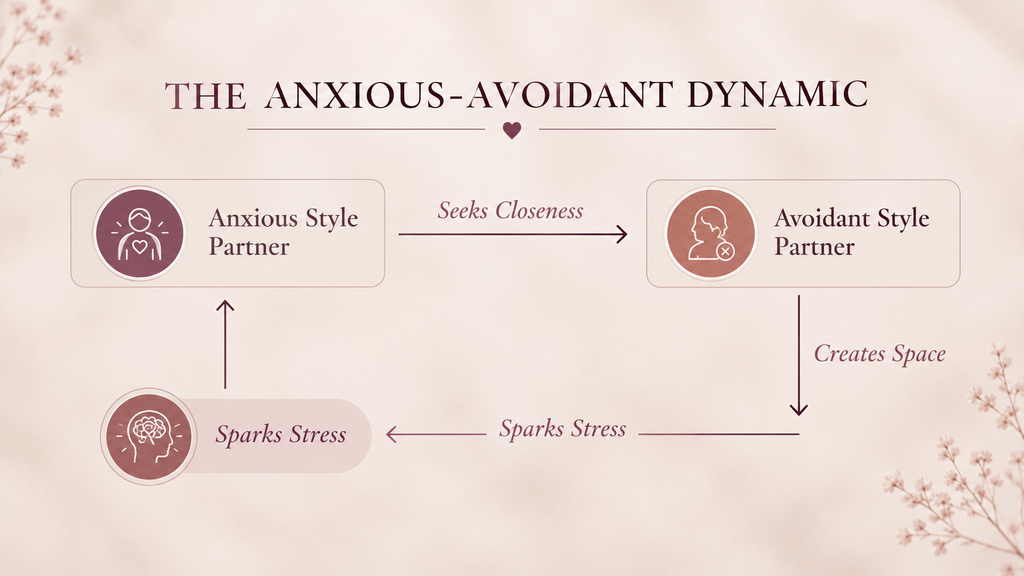
This push-pull dynamic feels incredibly intense, often mimicking the high-stakes passion portrayed in popular movies. When the avoidant partner pulls away, it triggers the anxious partner’s deep fear of abandonment, causing them to pursue harder. When the avoidant partner finally gives in and offers a moment of closeness, the anxious partner experiences a massive chemical rush of relief. Over time, however, this cycle becomes emotionally exhausting for both sides.
To truly break this cycle, you have to understand what is happening on the other side of the wall. Read our featured master-guide on [The 4 Defenses of Avoidant Attachment] to discover exactly why your partner pulls away when things get close, and what they are secretly feeling but struggle to express.
Anatomy of a Conflict: Changing the Narrative
To break this cycle, you must change how you communicate your relationship fears. Notice the vast difference between an anxious reactionary habit and a healthy expression of secure vulnerability:
| The Trigger Scenario | 🛑Anxious Protest Behavior (Unhealthy) | ✨Secure Vulnerability (Healthy) |
| Your partner doesn’t reply to your text for 5 hours. | “Clearly you’re too busy for me now. Fine, don’t talk to me.” | “Hey, I noticed you’ve been quiet today. I feel a bit disconnected when we go hours without talking, can we catch up tonight?” |
| Your partner asks for a quiet night alone. | “You’re getting sick of me. If you loved me, you’d want to spend time with me.” | “I love that you take care of your personal time. I’ll admit my anxiety spiked for a second, but I want you to enjoy your evening!” |
How to Transition Toward Long-Term Security?
An anxious attachment profile is a learned coping habit, which means it can be unlearned. Moving toward a secure communication style does not mean suppressing your deep capacity to care; it means shifting your primary source of validation from the outside world into yourself.
✨ Micro-Exercise: The 3-Step Reality Check
The next time your partner pulls away and stress sets in, pause and run your thoughts through this 3-step objective filter:
-
What is the raw, objective fact?
(e.g., “My partner hasn’t replied to my text for 3 hours.”) -
What story is my overthinking telling me about this fact?
(e.g., “They are getting bored of me and pulling away.”) -
What are two highly likely alternate explanations?
(e.g., “They are locked in a meeting at work,” or “Their phone battery died.”)
1. Implement the Strategic Reflection Pause
When you feel a wave of text-related stress or a sudden urge to demand reassurance, force a ten-minute pause. Allow the initial emotional surge to pass through your body before you send a message or voice a complaint.
2. Practice Mindful Cooling-Off
Instead of forcing your partner to calm your worries, practice internal emotional regulation. Remind yourself: “I am feeling reactive right now because of my past experiences, not necessarily because of my present reality.”
🔗 Sources & References
- • Levine, A. & Heller, R. — Attached: The New Science of Adult Attachment. TarcherPerigee.
- • Mikulincer, M. & Shaver, P.R. — Attachment in Adulthood: Structure, Dynamics, and Change. The Guilford Press. Read Digital Abstract