

Why Closeness Feels Like Pressure to an Emotionally Distant Partner
📌 At a Glance: Understanding Emotional Avoidance
- The Core Struggle: Valuing absolute self-reliance and using emotional distance as a protective shield against vulnerability.
- The Primary Trigger: Intense emotional conversations, heavy relationship expectations, or requests for deep commitment.
- The Healing Path: Expanding your window of tolerance for intimacy through small, conscious doses of openness.
In the initial stages of dating, an avoidant attachment style can easily masquerade as ultimate emotional maturity. Everything feels exceptionally calm, independent, and refreshingly drama-free. There are no frantic texts, no chaotic demands for reassurance, and no emotional instability.
However, a subtle shift occurs the moment the connection begins to deepen into true intimacy. As conversations become vulnerable, expectations rise, and true emotional commitment draws near, the avoidant partner instinctively takes a step back. They do not withdraw because they lack feelings, but because deep emotional closeness begins to feel indistinguishable from total suffocation.
Defense 1: Deactivating the Need for Connection
An avoidant attachment style is a behavioral pattern where self-reliance and emotional distance are used as protective shields against vulnerability. To an avoidant individual, relying on another human being feels fundamentally unsafe.
On the surface, they project a powerful aura of complete independence, unwavering confidence, and absolute emotional control. Underneath that armor, however, lies an unconscious terror of being exposed, judged, or controlled. They create invisible emotional boundaries to ensure no one gets close enough to truly hurt them.
💡 Clinical Terminology Callout: Deactivating Strategies Avoidant individuals unconsciously employ deactivating strategies to suppress their attachment needs and maintain distance. This includes focusing heavily on a partner’s tiny flaws, dreaming about an idealized “perfect, flawless partner,” or completely pulling away right after an incredibly close weekend spent together.
Defense 2: The Core Indicators of Avoidance
Core avoidant attachment patterns manifest through a series of subtle, protective behaviors designed to regulate the distance between themselves and their partners:
- The Intimacy Peak Retreat: Enjoying a beautiful, highly romantic moment, only to completely shut down or disappear for days immediately afterward to restore personal space.
- The Self-Reliance Rule: Refusing to ask for support or accept help, even during intense personal crises, because dependency feels like weakness.
- Vulnerability Suppression: Keeping internal thoughts, anxieties, and deep emotional truths entirely private, preferring to process problems in isolation.
- Defensive Devaluation: Creating flaws or focusing on trivial imperfections in a partner to justify pulling away or ending a serious relationship.

Imagine a scenario where a relationship is progressing beautifully toward moving in together. Instead of feeling joyful, the avoidant partner experiences a wave of anxiety, suddenly feeling an urgent need to take a step back. What changed wasn’t their love for their partner; it was the psychological pressure of building a shared life.
Defense 3: The Childhood Dismissal Root
This protective shield is forged during infancy and early childhood. This classic avoidant attachment pattern typically develops when a child’s early emotional needs are met with rejection, coldness, or severe emotional neglect by their primary caregivers.
When a crying child is consistently told to stop being dramatic, or is left to soothe themselves without comfort, their developing brain adapts to survive. The child’s mind creates a permanent rule: If I rely on others, I will be abandoned or hurt. I can only survive if I depend entirely on myself. In adulthood, this survival tactic acts as a permanent wall against intimacy.
Defense 4: The Internal Battlefront
From the outside, a partner struggling with avoidant attachment is frequently mislabeled as a heartless narcissist, a player, or someone who simply doesn’t care. In reality, their internal world is a deeply painful battlefield.
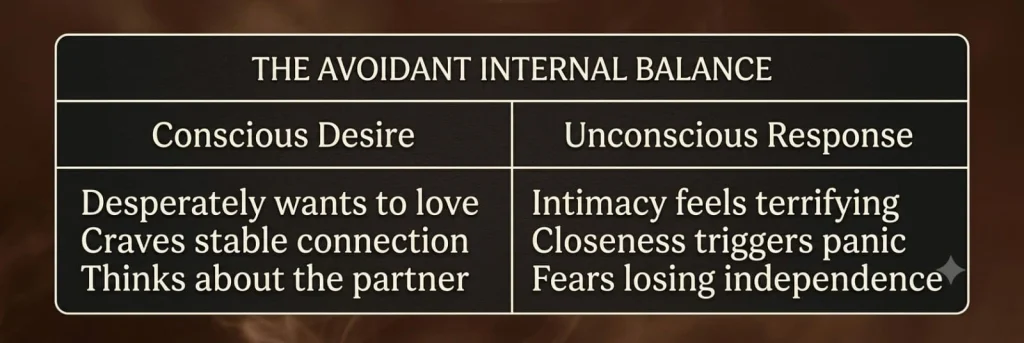
This inner conflict leaves couples trapped in an exhausting cycle of care and sudden withdrawal. When you pull back to protect your independence, you unconsciously activate your partner’s deepest abandonment fears, driving them to chase you harder. To understand how your distance triggers this frantic response, explore our guide on [The 4 Pillars of Anxious Attachment] to decode the psychology behind hyper-vigilant love and how to navigate it together.
They are often deeply in love, but their nervous system views that very love as a threat to their survival. They live in a constant state of internal tension—craving human connection, yet experiencing a fight-or-flight response whenever that connection becomes real.
Anatomy of a Conflict: Communicating the Need for Space
WWhen an individual with avoidant attachment encounters intense relationship conversations, their primary instinct is to shut down or run. Here is how you can reframe those moments to protect your independence without breaking your partner’s trust:
| The Emotional Trigger | Toxic Avoidant Response (Unhealthy) | Secure Boundary Setting (Healthy) |
| Your partner brings up a serious discussion about long-term commitment. | Completely goes silent, leaves the room, or claims “you are rushing and crowding me.” | “I love building a life with you, but thinking about the long-term future makes my anxiety spike. Can we take a step back and talk about this on Sunday?” |
| You are feeling overwhelmed and completely drained after a long social weekend together. | Disappears for 3 days without answering texts, making your partner feel abandoned. | “I had an amazing weekend with you. My social battery is completely empty right now, so I’m going to take a quiet evening to myself to recharge. I’ll text you tomorrow morning!” |
Steps Toward Deconstructing Emotional Avoidance
Dismantling an avoidant attachment style requires intentional self-awareness rather than forced vulnerability. If you recognize these avoidant traits within yourself, you can slowly expand your window of emotional tolerance:
🛠️ Micro-Exercise: The “Stay Two Minutes Longer” Rule
The next time you are having an intimate or serious conversation with your partner and you feel that sudden, uncomfortable urge to change the subject, shut down, or walk away—force yourself to stay physically and emotionally present for just two more minutes. Breathe through the initial discomfort. This simple action retrains your nervous system to understand that emotional vulnerability is not fatal.
1. Map Your True Withdrawal Triggers
Start noticing the exact moments you feel an impulse to pull back. Is it after a deep conversation? Is it when your partner asks about the future? Recognizing these triggers helps you see your avoidant attachment distance as a fear response rather than a lack of love.
2. Practice Micro-Doses of Vulnerability
You do not have to share your deepest traumas overnight. Start small. Share a minor work frustration or a small personal thought with your partner, proving to your nervous system that sharing your inner world is safe.
Scientific References & Citations
- Analysis of avoidant behavioral defenses and intimacy models adapted from Psychology Today.
- Systems for processing emotional deactivation referenced from Very well Mind.
- Childhood emotional neglect and developmental attachment schemas supported by clinical insights from Healthline.