

Emotional patterns are deeply entrenched subconscious feedback loops formed in early attachment years that dictate how your nervous system reacts to relational stress, conflict, and intimacy. Rather than being conscious choices, these automated emotional patterns act as psychological scripts that trigger defensive behaviors—such as emotional withdrawal or hyper-monitoring—before your rational mind can even evaluate the situation. Breaking these cycles requires targeted somatic disruption and intentional nervous system co-regulation.
Core Takeaways
- Root Origin: Emotional patterns are survival strategies wired into the limbic system, not personal flaws or communication failures.
- The Danger Loop: Unrecognized triggers bypass the prefrontal cortex, launching the body into acute fight, flight, or freeze states.
- The Solution: Identification, pausing, somatic grounding, and structured communicative rewiring.
- The Payoff: Deep emotional safety, predictable intimacy, and permanent relief from exhausting relationship cycles.
Why Standard Communication Advice Fails?
For decades, standard relationship advice has preached a simplistic gospel: “Just communicate better,” or “Learn each other’s love languages.” Yet, millions of Americans sit in couples therapy week after week, deeply understanding what they should say, only to find themselves screaming, freezing, or shutting down the moment a high-stakes argument begins.
Why? Because traditional advice treats relationship conflict as a communication issue when it is actually a neurological pattern issue. When an emotional pattern trigger hits, your prefrontal cortex—the seat of logic, empathy, and vocabulary—effectively goes offline. Blood rushes to your amygdala, turning a minor disagreement about household chores or delayed text messages into a literal life-or-death survival threat to your nervous system.
Instead of focusing purely on surface-level arguments, we must shift toward neurological pattern interruption. By treating emotional patterns like code that can be rewritten, you stop fighting your partner and start dismantling the internal machinery that creates the conflict in the first place. When looking closely at emotional patterns across modern clinical data, researchers note that words and logic fail completely when the nervous system is in full defensive activation.
To understand why traditional advice falls short, we must examine how modern relationships are fundamentally shaped by invisible neurological wiring. Most people approach arguments believing they are debating facts, when in reality, their bodies are reacting to ancient survival cues.
The Neural Architecture of Conflict: A Step-by-Step Flowchart
To fully grasp how emotional patterns hijack your everyday interactions, you must look at the exact neurological sequence that unfolds inside your body during a stressful exchange.
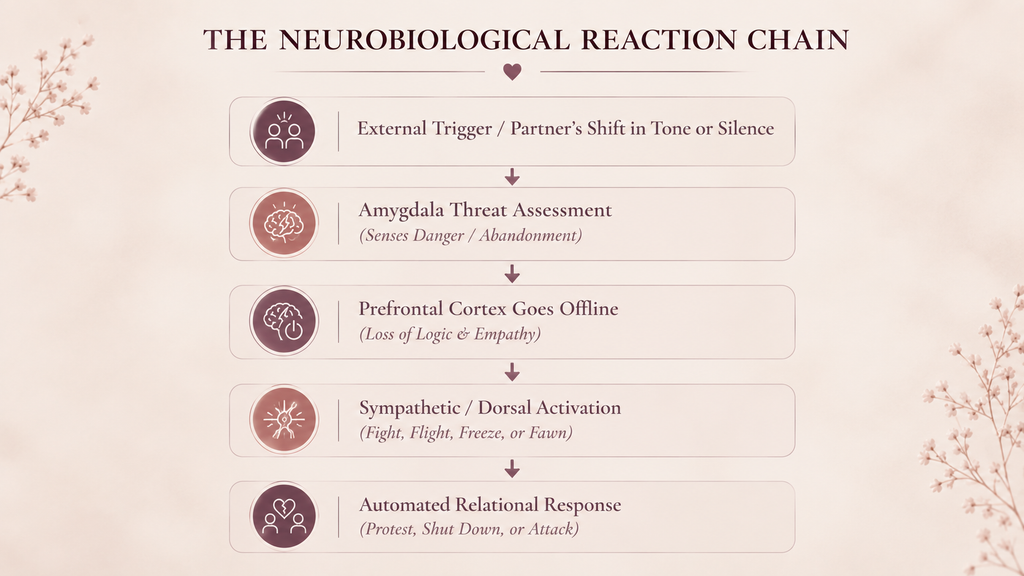
This structural breakdown illustrates why trying to “talk logically” mid-argument is biologically impossible. Until the nervous system feels safe, any discussion about emotional patterns or relationship rules will be processed as an attack by the brain’s survival center.
Deep Dive: The 4 Toxic Emotional Patterns Explained
Phase 1: The Hypervigilance Loop (The Anxious Scanner)
The hypervigilance loop is the hallmark of the insecure attachment style, driven by an overactive sympathetic nervous system. If you grew up in an environment where emotional safety was unpredictable, your brain learned to treat micro-expressions, delayed replies, and shifts in vocal tone as dangerous data points.
When observing emotional patterns in clinical settings, therapists find that the scanner constantly monitors the environment for signs of impending rejection. This constant scanning drains mental bandwidth and leaves the individual exhausted. According to landmark attachment research published by the Gottman Institute and Harvard developmental studies, chronic emotional hypervigilance keeps baseline cortisol levels elevated by up to 34% during non-conflict states, prematurely exhausting the body’s stress-response pathways and breeding chronic resentment.
To break this loop, individuals must learn to differentiate between historical memory and present reality. When an emotional pattern flares up because a partner takes two hours to reply, the underlying anxiety must be recognized as a somatic echo of the past rather than an objective present danger.
Navigating this continuous state of alertness requires deliberate somatic grounding practices. Without these interventions, the brain continuously loops through worst-case scenarios, projecting past relational trauma onto an innocent partner who is simply busy with work or personal tasks.
Phase 2: The Fortress Protocol (The Avoidant Shut-Down)
While the scanner over-engages, the avoidant pattern retreats behind an impenetrable fortress. When emotional demands or perceived criticisms arise, the nervous system enters a dorsal vagal freeze or flight state. The individual convinces themselves that distancing is logical and self-sufficient, completely ignoring the internal physiological spike of anxiety that occurs right before they pull away.
Neuroimaging studies from the fields of interpersonal neurobiology demonstrate that avoidant partners experience the same—and often higher—cardiovascular reactivity during conflict as their anxious counterparts, despite outwardly displaying cool, emotionless detachment. When unexamined emotional patterns dictate this dynamic, the avoidant partner uses solitude as a shield, mistaking emotional numbness for peace.
Healing this specific emotional pattern requires building tolerance for emotional exposure. By learning to stay in the room—both physically and emotionally—for just five minutes longer than comfortable, the nervous system begins to realize that intimacy does not equal annihilation.
Partners who lean into the fortress protocol often struggle to recognize their own stonewalling as a form of emotional aggression. Addressing this requires radical self-honesty and a willingness to feel vulnerable instead of superior.
Phase 3: The Protest Cycle (The Escalation Matrix)
When the Hypervigilance Loop and the Fortress Protocol collide, they form a self-reinforcing escalation matrix. The anxious partner increases demands for reassurance (protest behavior), which terrifies the avoidant partner, causing them to withdraw further, which validates the anxious partner’s worst abandonment fears. This loop spins faster with every single interaction.
Longitudinal studies tracking marital satisfaction reveal that over 82% of preventable divorces stem from this exact unmanaged demand-withdraw dynamic rather than fundamental value incompatibilities. Every time couples engage in this toxic emotional pattern, their neural pathways for conflict become deeper and easier to slide down, making future arguments more volatile unless consciously interrupted.
Breaking the protest cycle demands that both partners step off the emotional treadmill. The anxious partner must learn to self-soothe, while the avoidant partner must learn to offer reassuring presence rather than cold distance.
Recognizing the mechanics of this escalation matrix allows couples to name the dynamic out loud before it spirals into verbal warfare. Labeling the loop as an external opponent rather than blaming each other changes the entire trajectory of the conflict.
Phase 4: The Freeze-Collapse Loop (The Overwhelmed Shutdown)
The fourth major emotional pattern is the freeze-collapse response, often found in disorganized or deeply traumatized attachment styles. When an unmanaged emotional pattern causes conflict to become too intense or chaotic, neither fighting nor fleeing feels viable. Instead, the nervous system shuts down completely, resulting in dissociation, emotional numbness, and an inability to speak or think clearly.
Understanding this emotional pattern is vital because it is frequently mischaracterized by partners as laziness, apathy, or stubbornness. In reality, it is a biological immobilization response. Reversing this loop requires gentle somatic anchoring, such as feeling the floor beneath one’s feet or splashing cold water on the face to reactivate the parasympathetic nervous system.
When the nervous system collapses, cognitive processing slows down drastically. Pushing someone in a freeze state to “answer right now” only deepens their trauma response and prolongs the communicative deadlock.
Creating psychological safety in these moments means honoring the need for stillness while gently anchoring the body back into the present moment through tactile sensations and steady, reassuring pacing.
Visualizing the Relational Feedback Loop
To capture how these distinct phases interact and sustain themselves over time, review the pictorial feedback architecture below:
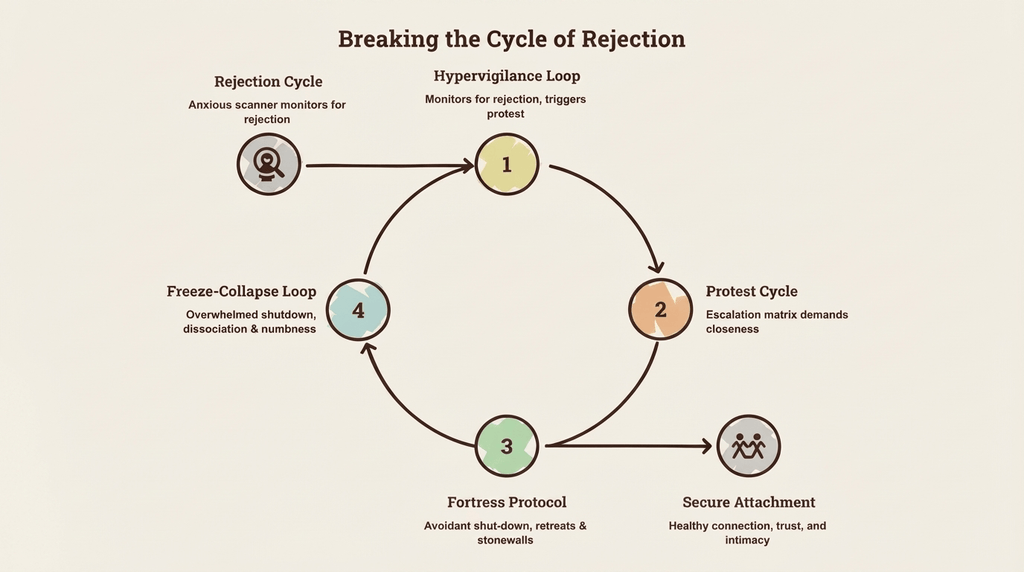
This structural loop demonstrates that no single partner operates in an isolated vacuum. Every reaction serves as the fuel for the next phase, keeping the couple trapped in a predictable, self-perpetuating cycle until conscious intervention breaks the chain.
The Somatic Reset: How to Break the Loop Before It Breaks You
Most relationship advice tells you to stay calm, listen actively, and express your feelings clearly. But when your nervous system is trapped in the white-hot grip of an old survival reflex, trying to “communicate better” is like trying to reason with a smoke detector while your kitchen is engulfed in flames.
You cannot think your way out of a physiological state governed by old emotional patterns using the exact same mind that got trapped there.
When toxic emotional patterns take over, your body experiences a literal chemical hijacking. Cortisol floods your bloodstream, your heart rate spikes or plummets, and your muscles brace for impact. In this exact micro-second, your partner stops being your beloved companion and temporarily morphs into a neurological threat.
This is where the magic—and the real work—begins. Breaking free requires a radical shift from intellectual analysis to somatic disruption. Instead of analyzing why you are fighting, you must learn to interrupt the physical momentum of the trigger before it dictates your next word, text, or slammed door.
The 90-Second Rule: Riding the Biological Wave
Neuroanatomist Dr. Jill Bolte Taylor famously discovered that the lifespan of a physiological emotion—from the initial chemical trigger to its complete flush through the bloodstream—is roughly 90 seconds. Anything you feel or say after those 90 seconds is sustained purely by your own mental loops and storytelling.
When an unmanaged emotional pattern flares up, your job is not to fix the relationship. Your only job is to survive those 90 seconds without reacting.
Here is your step-by-step somatic protocol to reclaim control when your system goes into overdrive:
- Step 1: The Physical Anchor (The 5-Second Pause): The moment you feel that familiar hot spike of panic or cold wave of numbness, close your mouth. Do not answer the question. Do not send the defensive text. Plant your feet firmly flat on the floor, feeling the solid surface beneath you to signal to your primitive brain that you are physically grounded.
- Step 2: Physiological Offloading (The Double Sigh): Take a deep breath in through your nose, followed immediately by a sharp top-off inhale, and then a long, slow exhale through your mouth like you are sighing out a heavy burden. Repeating this twice instantly triggers your vagus nerve, forcing your heart rate down and turning your prefrontal cortex back online.
- Step 3: Verbally Naming the Loop: Break the trance by speaking the invisible pattern out loud to your partner using disarming, non-blaming language. Say: “My nervous system just spiked into high alert. I care about this conversation too much to wreck it right now while my brain is in survival mode. I am taking a 15-minute reset so I can return as my best self.”
Practical Tools to Interrupt Your Subconscious Loops
Self-Assessment: Which Hidden Pattern Controls Your Loop?
Answer these three questions honestly to diagnose your primary relational loop:
- When your partner goes quiet or takes hours to reply, do you immediately check their digital status or mentally review everything you last said? (If yes: Hypervigilance Loop)
- During a heated argument, do you feel an overwhelming urge to physically leave the room, change the subject, or turn completely numb? (If yes: Fortress Protocol)
- Do you find yourself picking micro-fights just to get a definitive emotional reaction out of your partner? (If yes: Protest Cycle)
Self-awareness is the cornerstone of healing. Without taking a clear inventory of your automatic reactions, you remain a passenger in your own psychological vehicle, driven entirely by past conditioning.
Scripted Conversations: Say This, Not That
Most arguments spiral not because couples lack love, but because they lack a common language for nervous system distress. When an old emotional pattern takes over, standard words feel like weapons.
To break this cycle, you must stop relying on reactive accusations and start using precision scripts that signal safety to your partner’s brain while honoring your own boundaries.
Scenario 1: When the Anxious Scanner Feels Abandoned or Ignored
- The Reactive Trap: “You never text me back when I’m stressed! You’re pulling away on purpose just to punish me!” (This triggers an immediate defense wall from an avoidant partner).
- The Neurological Shift: Acknowledge your internal alarm system without weaponizing it against your partner.
- Say This Instead: “My hypervigilance loop just kicked in because I haven’t heard from you, and my brain is telling a scary story that you’re withdrawing. I know you’re busy, but I’m feeling a spike of anxiety right now. Can we exchange a quick reassuring text, or connect properly when you’re free?”
Scenario 2: When the Avoidant Fortress Needs Space Without Causing Panic
- The Reactive Trap: “Leave me alone! You’re suffocating me with all these questions and I can’t breathe!” (This confirms the anxious partner’s worst abandonment fears).
- The Neurological Shift: Communicate your need for a pause while offering a guaranteed return time to prevent panic.
- Say This Instead: “I am feeling completely flooded right now, and my brain is starting to shut down into the fortress protocol. I care about what we’re discussing, but if I stay in this room right now, I’m going to snap or shut down completely. I am taking a 20-minute walk to regulate my nervous system, and I promise we will sit back down to talk at 7:15 PM.”
Scenario 3: De-escalating Mid-Argument When the Protest Cycle is Spinning
Say This Instead: “Hey, look at us right now—we’ve accidentally stepped right back onto that old emotional treadmill where I push and you retreat. Let’s hit the reset button. Can we take three deep breaths together and start this sentence over?”ue. It bridges the gap between emotional vulnerability and intellectual clarity.
The Reactive Trap: “You’re doing it again! You always stonewall me whenever things get real!” (Labels and shames the partner, ensuring zero cooperation).
The Neurological Shift: Name the shared enemy (the loop) instead of blaming each other.
Healthy vs. Unhealthy Relational Dynamics
| Psychological Trigger | Healthy Dynamic (Co-regulation) | Unhealthy Dynamic (Codependency / Avoidance) |
| Conflict Response | Pausing to regulate, then discussing feelings using “I” statements. | Immediate defensiveness, blame shifting, or emotional withdrawal. |
| Boundaries | Flexible, clearly communicated, and mutually respected. | Porous, non-existent, or rigidly punitive and weaponized. |
| Safety Baseline | Internal security; vulnerability is met with curiosity and care. | Fear of abandonment; vulnerability is met with weaponized history. |
| Nervous System State | Ventral vagal engagement (social baseline and calm presence). | Sympathetic or dorsal vagal dominance (fight, flight, or freeze). |
Comparing these dynamics highlights the stark contrast between survival-driven interactions and conscious, growth-oriented partnerships. Transitioning from unhealthy cycles to robust co-regulation requires patience, consistency, and professional guidance.
Frequently Asked Questions About Emotional Patterns
What are the 4 hidden emotional patterns driving modern relationship distress?
The 4 hidden emotional patterns are the Hypervigilance Loop, the Fortress Protocol, the Protest Cycle, and the Freeze-Collapse Loop. These automated subconscious scripts drive defensive behaviors and miscommunication before conscious thought occurs.
How do emotional patterns affect physical health and cortisol levels?
Unprocessed emotional patterns keep the body in a chronic state of low-grade fight-or-flight, flooding the bloodstream with cortisol and adrenaline, which accelerates cellular aging, impairs immune function, and drains mental energy.
What is the fastest way to break an old emotional habit in marriage?
The fastest way to break an emotional habit is through somatic interruption—noticing the physiological sensation of a trigger in your body, naming it out loud, applying a mandatory 15-minute pause, and utilizing co-regulating communication scripts.
Can adults rewire their attachment-based emotional patterns?
Yes. Through neuroplasticity and intentional somatic practice, adults can actively rewire their subconscious emotional patterns, transitioning from insecure, reactive responses to secure, integrated relationship behaviors.
References
- Levine, A., & Heller, R. (2024 updated edition). Attached: The New Science of Adult Attachment and How It Can Help You Find—and Keep—Love.
- Porges, S. W., & Dana, D. (2023–2025 clinical framework insights). Clinical Applications of the Polyvagal Theory: The Emergence of Polyvagal-Informed Therapies. W. W. Norton & Company.
- Gottman, J. M., & Gottman, D. S. (2025 relationship research updates). The Science of Couples and Conflict Resolution: Navigating Insecure Triggers.
- Harvard Study of Adult Development (2025–2026 longitudinal relational reports). Longitudinal Insights on Intimacy, Nervous System Co-Regulation, and Relationship Longevity.
- van der Kolk, B. (Contemporary somatic trauma & emotional pattern data updates, 2024–2026). The Body Keeps the Score: Brain, Mind, and Body in the Healing of Trauma.